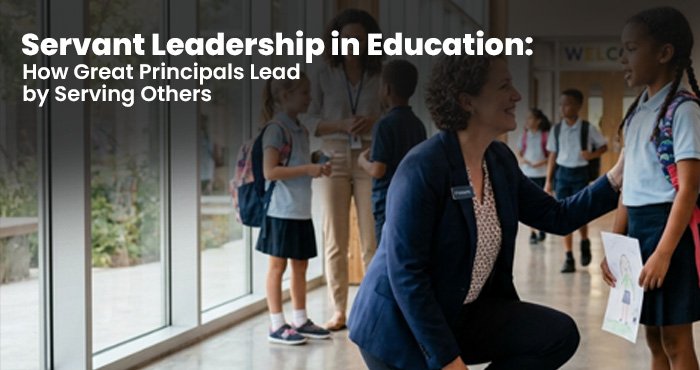
When thinking about a leader, most would associate the term with somebody at the top, somebody who directs, decides, and wields power over others. And although that may be an aspect of leadership, great leaders in the education world throughout the ages knew better than to just assume their leadership role was meant for directing from above.
Servant leadership in education flips the traditional picture of a principal upside down. It is not asking how we, as administrators, can make our employees assist us in reaching our objectives; it is asking how we can help our employees reach their maximum potential so that they can serve our school. This change in perspective has huge implications for how our schools feel and operate.
This blog is dedicated to all those principals, vice-principals, and administrators who wish to lead with a difference. If you wish to create an environment in which your teachers feel valued, your students are cared for, and your community is proud of you, servant leadership in education is where that kind of school begins.
What Servant Leadership in Education Really Means
Servant leadership is not a new idea, but it is one that gets misunderstood often. Some leaders hear the term “servant” and fear it means that they will be considered a weakling or lacking in leadership. This is not the case at all. Servant leadership involves taking the position of using one’s authority for the betterment of others.
In terms of a school, a servant leader will be a principal who wakes up each day thinking about how best they can help their teachers excel. They will get rid of any hindrances. They will conduct meaningful conversations, and they will advocate for the allocation of resources that will benefit the students.
This type of leadership requires one to have true humility. One needs to have enough self-assurance to realize that their value as a leader does not lie in being the most influential individual in that particular situation but the most beneficial one.
Why Servant Leadership Principles Matter More Than Ever in Schools Today
Contemporary American educational institutions are under significant pressure as a result of teacher shortages, student health issues, recovery from the pandemic, and a need for the school to act as an anchor within its community. Under such circumstances, the leadership approach taken by the principal is highly important.
Servant leadership principles give school leaders a clear and human-centered framework for navigating all of that pressure without losing sight of what matters most — the people. In an administration that is based on service-oriented leadership, teachers will feel taken care of instead of being left to fend for themselves. Students will be recognized for who they are as opposed to just being processed by the system.
The schools that are doing well today – those that have vibrant cultures, committed teachers, and students who really want to be there are almost always led by someone who has embraced servant leadership principles in both their words and their daily actions.
Servant Leadership Principles Every Principal Should Practice
Put People Before Programs
One of the core servant leadership principles is that people always come before programs. Even if a principal has developed the best academic program in the district, yet if his/her teachers who are going to execute that program feel dejected and exhausted, that program is not going to succeed. People are not mere means to implement any program. On the other hand, the program is the means to serve the people.
The basic question which a principal must always ask while taking any decision is – how is this going to affect my staff and my students as individuals? Not just as professionals or as people appearing for exams, but as individuals with lives and problems.
Listen With the Intention to Understand, Not to Respond
The servant leader hears things differently from the ordinary leader. They do not hear in order to acquire information or make an argument in support of a decision they have already made. They hear in order to know — what is the experience of this person, what does he need, and how can I assist him?
Effective educational leadership is deeply rooted in this kind of listening. When teachers feel genuinely heard, not merely controlled or diverted, but truly understood, they place their trust in their leader. They communicate in a more authentic way. They bring themselves into their roles more. And that authenticity becomes the cornerstone of the culture that allows true growth to occur at the school.
Clear the Path Instead of Controlling It
Whereas many principals exert themselves attempting to control results through surveillance of performance, procedures, and behavior, a servant leader takes a different approach. Rather than controlling the route, a servant leader clears the route by identifying the obstacles preventing his teachers from working effectively and removing each one of them.
This may involve cutting back on a meeting that really is not needed. This may involve lobbying at district headquarters for more planning time. This may involve handling a troublesome parent himself so that his teachers can focus on their students. Such service is often quiet and unnoticed; however, its impact is felt deeply and generates loyalty that is truly remarkable.
Transformational Leadership in Schools Begins With Serving First
Transformational leadership in schools and servant leadership are not opposites; they are inseparable. A transformational leader is one who brings about change, instills vision, and helps the school move beyond its current state. However, the sustainability of this change depends on its basis of serving the people who are going to be changed.
You cannot inspire people who do not trust you. You cannot create a vision that people will follow if they feel unvalued. Transformational leadership in schools works best when teachers believe that their leader is genuinely on their side, that the change that they are being asked to make is for themselves and for the benefit of their students and not just because of some number or figure that needs to be satisfied.
When a principal builds that trust through the acts of service that he engages in, then the doors to transformation open up by themselves. The teachers no longer have to be subjects of the transformation process; they become partners in the process. The change is not something that is imposed but something that is willingly chosen.
Student-Centered Leadership — The Natural Outcome of Serving Your Staff
There is something that many school administrators don’t realize until they experience it: if you support your teachers, your teachers support your students in a far greater way. That is how direct the link between them is. Student-centered leadership is not only about serving the students at the top level. It is about making sure that all around the school there is an environment created where every adult feels supported, encouraged, and valued to do their very best for the children sitting in front of them.
If a teacher feels unsupported, controlled, and neglected, then he or she will still serve the interests of his or her students but from an energy-depleted position. If a teacher feels truly supported by his or her principal, valued in his or her professional opinion, and appreciated for all his or her efforts, he or she will serve the interests of students from an energy-rich position.
Student-centered leadership starts at the top, with a principal who understands that the best thing they can do for every student in their building is to truly show up for every teacher on their staff.
Becoming a Better School Leader — A Daily Practice, Not a Destination
Becoming a better school leader is not something that happens after attending a conference or finishing a degree program. It is an everyday process, based on countless little decisions – whether to listen rather than judge, to serve rather than to control, to accumulate rather than to manage.
Every day brings a new chance for a principal to exercise servant leadership in education how you greet your staff at the door. How you react to a teacher who approaches you upset. How you face a hard choice that involves real people. Such instances – coming every day anew – are the ones that make you the leader you grow into.
Leadership styles for school principals can vary, and there is no one-size-fits-all approach. However, the leaders who have the most meaningful impact on their schools are often those who embraced the role of service over the easy route of wielding authority.
Practical Ways to Lead With a Servant Heart Starting This Week
A new system or a plan for the future is not required to practice servant leadership today. The small steps that one will take deliberately will bring about change gradually and eventually transform the culture. Below are some practices that one can adopt in order to make this transformation a reality:
- Every day, ask one teacher, “What do you need from me right now?”
- This month, remove an unnecessary task or obligation for your staff members
- At least once a week, praise a teacher’s work with sincere intentions and be specific in doing so
- Once a day, hold an agenda-free conversation with one student
- This month, share with your staff one mistake that you have made and what lessons you have learned from it
This list does not contain any grand gestures. However, with time, these practices will show who you are as a leader. This message will eventually transform your school community from within.
What Dr. Eugene Wallace School Leadership Insights Teach Us About Serving Others
For anyone interested in servant leadership principles and applications, the work of Dr. Eugene Wallace provides a great opportunity to study these concepts in an educational environment. For years, Dr. Wallace has been a consultant for school principals, educators, and community leaders, and his knowledge of servant leadership is not abstract; he has gained that knowledge through experience.
In The Ripple Effect of School Culture, Dr. Wallace tells us a lot about leadership, culture of schools, and how much leaders are responsible for serving the people they lead. Trust, true care, accountability, and shared mission and vision of educators and students create such conditions in which everyone can thrive.
It is hard to say why the thoughts of Dr. Eugene Wallace are so appealing to the principals and other administrators. He writes from the middle of the work with empathy for how hard the job is and with deep conviction that effective educational leadership grounded in service is the path forward for every school that wants to be something worth belonging to.
Conclusion
Servant leadership in education is not the easiest path. When you are exhausted, it tells you to place others above yourself; when you have something to say, it tells you to listen; when you bear an impressive title, it tells you to serve, not to be served. But this is the only real way.
The schools that really make a difference in the lives of their students are always the ones headed by those individuals who chose service over status, people over programs, and trust over control. That is what servant leadership in education looks like in practice — and it is available to every principal who is willing to lead from the heart.
If you are ready to go deeper into becoming a better school leader through the lens of service, purpose, and true human connection, discover more about the wisdom of Dr. Eugene Wallace in the field of school leadership and get the advice that will fit you perfectly. If you are ready to move forward in your career in leadership, contact Dr. Eugene Wallace and begin constructing a school for which people will be grateful to work.
FAQs
1. What is servant leadership in education and how is it different from traditional leadership?
Servant leadership in education is a leadership approach where the principal prioritizes the needs of their teachers and students above their own authority or image. Unlike the old school of leadership, which is one of downward influence, the new form of servant leadership involves influencing upward by creating a conducive environment for people and helping to eliminate any barriers.
2. What are the core servant leadership principles every school principal should know?
The core servant leadership principles for school principals include listening with genuine intent to understand, putting people first rather than programs, making the way clear for the teachers to work at their best, honesty and accountability, and always putting the interests of the school community ahead of comfort or self-glory. It is by living these values day to day that schools are built on trust.
3. How does transformational leadership in schools connect to servant leadership?
Transformational leadership in schools and servant leadership work together naturally. For a leader to make any transformation, they need to have the trust of their employees, and the way one earns the trust of the employees is by doing service to them. This is why transformation done through servant leadership is very sustainable compared to imposed transformation.
4. How can a principal become more student-centered through servant leadership? Student-centered leadership
Develops automatically from the servant leader model since when a principal serves his/her teachers, then those teachers become better prepared and more willing to serve the students. A principal develops into a more student-oriented leader by starting with identifying the needs of the teaching staff members because any well-supported teacher is definitely a better one.
5. Where can school leaders find real guidance on becoming a better school leader through servant leadership?
The book “The Ripple Effect of School Culture” by Dr. Eugene Wallace is a great place to start. This is a very candid and heartwarming book that talks about servant leadership, education leadership, and what it takes to be a servant leader in a school environment. Explore Dr. Eugene Wallace’s school leadership insights for more guidance on becoming a better school leader every single day.