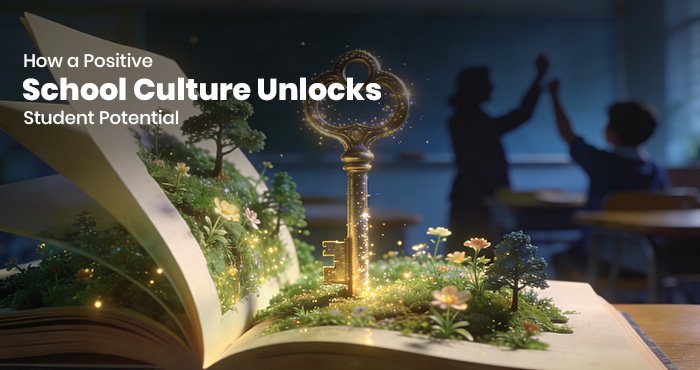
The student must have something happen for learning to take place. They must feel secure. They must feel a part of the group. They must feel that those in charge truly believe in them. Unless this happens, all the fine lessons taught in all the excellent classrooms will fall flat.
That foundation here is a positive school culture. And it is probably one of the most effective means available for shaping young students into their best selves. It does not cost a great deal. It does not need a program or a large amount of money. All it needs are individuals committed to doing things deliberately for each and every student every day.
This blog will walk you through exactly how positive school culture connects to student potential development, why it matters more than most people realize, and what you can do inside your school to make that connection stronger starting right now.
What Positive School Culture Really Means for Students
Many people associate school culture with pep rallies and decorated hallways. However, it runs a lot deeper than that. Positive school culture is the invisible environment that either lifts students up or quietly holds them back, and this is something that most students feel the moment they enter the classroom.
This can be noticed from the reactions of the teachers whenever a student gives a wrong answer to their questions. This can be sensed through whether the corridors are calm or busy. This can be witnessed by seeing whether or not a struggling student receives help or remains unaided in silence.
If all these happen in an environment of mutual respect and discipline, then the students begin to realize that there, they have a chance to grow. And once that belief takes root in them, then something changes within them. They ask more questions. They stop hiding and start showing up fully, and that is where real student potential development begins.
The Real Connection Between School Environment and Student Motivation
Students Rise to the Level of Their Environment
There is one basic principle that every teacher knows to be true about their students — that they are influenced by their surroundings. In a good environment, with positive influences, structure, and hope, they flourish. But in a poor environment, with negative influences, uncertainty, and indifference, they shield themselves.
Student motivation in schools is not something you can force with rewards alone. True motivation stems from having a sense of connection to someone or something – a teacher who cares, a classroom that values hard work, and a school where each individual student truly feels valued. Such an atmosphere cannot be achieved by chance and must start with the culture created by the organization’s leaders.
The Impact of Environment on Students Goes Beyond the Classroom
The impact of the environment on students reaches far beyond test scores and grades. It determines how they view themselves. It determines how they see themselves as having the capability to learn difficult things. It determines how they behave towards one another once they leave the confines of school.
If the child grows up in a school environment where respect and support are abundant, he/she will end up developing a trait that no class is ever able to teach him/her – that he/she belongs in rooms where important decisions take place.
Student Success Strategies That Start With Culture
Build Relationships Before Routines
One of the most effective student success strategies is also one of the simplest — relationships first. Prioritize connecting with kids before getting into routines, expectations, or educational goals. Ensure all kids in your building know that there is at least one adult in that building who really knows who they are and that they care about their well-being.
As research has shown time and time again, students do better when they know that they matter to an adult within the school environment. This does not mean sitting down and talking for hours and hours. It could mean simply saying hi in the hallway and knowing just a little something about their lives, or cheering them up after a difficult day.
Make Growth Visible and Worth Celebrating
Another powerful student success strategy is changing what gets celebrated inside your school. When only those at the top of the class receive accolades and recognition, a very big portion of the student population concludes silently that they are just not meant for success. But when there is appreciation for growth, where there is recognition of the child who was struggling last month but did better this month, then the whole picture is totally different.
This kind of mentality communicates to all the learners that this school is a place where hard work pays off. It is a place where effort makes a difference. And that it doesn’t matter whether one is excellent or not, they still deserve recognition.
Give Students a Voice in Their Own Learning
Students who feel heard will remain engaged. Making feedback easy for the students and encouraging them to ask questions, and feel like active participants in their education, is one of the most underused tools in building a positive school culture.
But this does not mean that students actually run the school; what it means is that they have been respected well enough for them to have a say in how the school operates. This makes them feel like they own everything, and this kind of attitude will make a difference to the way that they learn.
How Positive School Culture Develops a Student Growth Mindset
A student growth mindset — the idea that one can become more intelligent and skilled through hard work — does not emerge in a vacuum. It develops in contexts where mistakes are okay, where effort is appreciated, and where the adults present demonstrate a similar attitude toward learning and openness as expected of students.
Schools with a strong positive school culture naturally develop this mindset in their students because the values around them reinforce it every day. If a teacher asks the class, “I don’t know either, but we can figure it out together,” and the school administrator walks around the hallways questioning students about what they are learning, they silently instill the idea of continuous growth in their minds.
Over time, this student growth mindset becomes part of who a student is. Instead of asking themselves, “Am I smart enough?” they start asking, “What do I need to learn to become smarter?” This shifts their whole attitude towards tackling difficulties both within the school setting and beyond it.
Dr. Eugene Wallace School Culture Insights — A Book Leaders Need to Read
However, for the in-depth analysis of how school culture can impact the potential of the students, the work of Dr. Eugene Wallace should be reviewed. The author’s professional experience gained in collaboration with school communities, educators, and principals allows him to make valuable comments on the topic.
In his book titled The Ripple Effect of School Culture, the author describes what results from establishing culture within the institution. Using his profound knowledge and rich experience, Dr. Wallace provides insight into how the culture established by the leaders of the school affects the behavior of the students, the approach used by teachers, and the overall performance of the institution.
The value of the discussed literature work is defined by its unique authenticity. In other words, it is not based on theoretical assumptions or hypotheses and provides the reader with profound information about the role of school culture in the life of the institution. Therefore, the readers will definitely find useful information about their school and students in this book.
Conclusion
There is a lot of untapped potential in every student. The issue is not about whether this potential is present or not, because it always is. It is about whether the environment at school facilitates its realization and manifestation.
Positive school culture is the answer to that question. It is the environment that tells every student, “You matter here, you fit here, and we have faith in your potential.” It takes time, effort, and dedication from all the adults who work there to create that environment. But the rewards it reaps are eternal.
Are you prepared to raise your school culture to new heights and discover the capabilities of your students? Check out Dr. Eugene Wallace’s school culture insights to get expert advice based on decades of experience in actual classrooms. Are you ready to discuss the unique requirements of your school? Then contact Dr. Eugene Wallace.
FAQs
- What is positive school culture, and how does it affect students? Positive school culture
The positive classroom environment is one based on trust, respect, and ongoing encouragement, and it allows every student to feel safe and respected. It has an impact on the students’ motivation, behavior, and self-concept.
- How does positive school culture support student potential development?
In such a case, where the learners are made to feel valued and respected, they become less guarded and begin striving towards excellence. It is in the presence of a positive school climate that student potential will develop effortlessly through good connections, achievements, and an atmosphere where all learners belong.
- What are the best student success strategies for schools to implement?
The most effective student success strategies include building real relationships between students and staff, Emphasizing growth over perfection, allowing student voices to be heard in their own education, and sustaining a positive and caring environment at school are the keys to creating such an environment.
- How does the impact of environment on students show up in real life?
The impact of environment on students shows up in how they feel about school, how they interact with other people, and whether they think they can succeed. When students learn in such an atmosphere, they acquire self-confidence, good behavior, and motivation to take up challenges beyond their academic years.
- Where can educators learn more about building positive school culture?
An excellent place to start is “The Ripple Effect of School Culture” by Dr. Eugene Wallace — an inspirational yet practical book packed with insights into how school administrators and teachers can develop a positive school culture that truly unlocks student potential development and creates lasting change for the whole community.