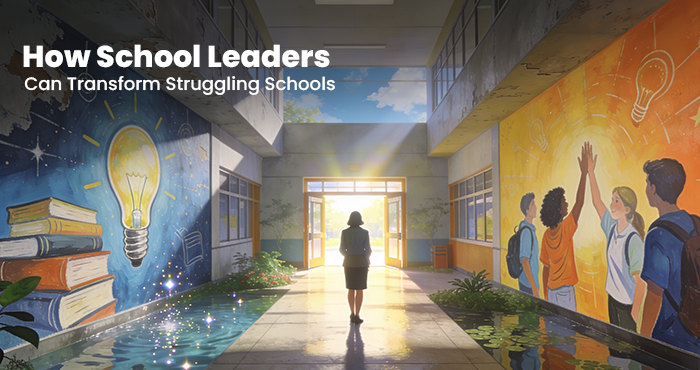
However, some institutions have a vibe that repels visitors. The atmosphere may lack positive energy. The staff could appear tired, and the students disinterested in learning. In such an institution, everything seems to be done without any goals or sense of purpose.
The fact is that behind any turnaround of an institution, there is always someone in a position of power who made a decision to act differently, not always successfully, but differently. This is what effective school leadership strategies imply.
I hope this blog will be interesting to all the principals, vice-principals, and school administrators who know their institution could be improved and are willing to put some effort into making changes happen.
Why So Many Schools Stay Stuck
Understanding the problem can be an important step before trying to solve it. The truth is that very few underperforming schools fail due to a lack of interest among their community members. What usually happens in such environments is that the system around fails to work properly. No one takes care of it, and no one makes an attempt to solve all the problems.
Teachers, students, and other members of the community start feeling neglected and ignored, while leaders find themselves so engaged in solving different issues that emerge each day that they simply forget to think about long-term improvement and building something new and more efficient. It creates a vicious circle that makes it impossible to develop successfully and effectively.
However, there is hope. With proper leadership strategies at schools, everything will become much easier.
School Leadership Strategies That Actually Make a Difference
Start With Trust, Not Rules
The first step a principal must take is to establish trust, not fear. Not compliance. But rather trust. If there is trust between a principal and the teachers, then you will have no trouble in bringing their problems to your attention. And if your students have trust in their surroundings, then you have created a learning environment free of any constraints.
Trust is established by doing what you promise you will do. By admitting to your mistakes or misjudgments. By appearing consistently and with equal treatment towards every single individual in your facility. No program or plan can substitute for that.
Listen Before You Lead
One of the least-used methods of school leadership is listening. When a new leader enters a failing school with an elaborate solution already formulated, all they are doing is failing to recognize the root cause of the problem. If you are to succeed as a leader, you must take some time to speak to everyone around you before implementing your solution.
Arrange meetings with your faculty for purposes other than evaluation. Find out from the learners what makes the school great and what changes they would recommend in the learning process. Speak to the parents, to the custodial staff, and any other employees in the institution. The solutions to the problems you seek are within that institution already.
Create a Clear and Shared Vision
What a troubled institution needs most of all is something that it may be said to lack. This is the ability to see where it is heading. People are busy, yet their energies are directed toward various ends. This is draining. It also causes friction without necessarily being meant to.
Effective educational leadership entails developing a vision that all members of the institution can grasp, articulate, and buy into. Not an eloquent mission statement that is hung up somewhere on the walls of the institution. But a concrete image of what this institution stands for and what role each member plays in realizing this vision.
Principal Leadership Skills That Drive Real School Improvement
The Ability to Stay Calm Under Pressure
In troubled schools, there is no shortage of stress. There are issues with money, personnel, students’ behavior, and community problems, all at once. How a principal deals with stress says a lot about the entire institution.
If a leader remains cool, composed, and concentrated during difficult times, he or she will give off a very strong signal to others. He or she will communicate that we have got this, we will not lose it. This is among the most crucial qualities of a school principal.
Knowing How to Develop the People Around You
A good school can be no better than its teachers. And good teachers can only come from a supportive environment. The single best way to improve a school that a principal could ever employ would be to focus his energies on building up the staff he already has.
It isn’t always expensive training courses that help build up teachers. Sometimes it’s sitting down in class and offering constructive criticism. Sometimes it’s pairing a less seasoned teacher with someone who knows a little more. And sometimes it’s simply asking the question, “What do you need to do your job better?” and answering it.
Making Decisions With Data and Heart
Excellent leadership within the schooling sector will never be all about statistics. It will not always be about emotions, either. However, the most effective school leaders know how to balance the two, understanding from the statistics the progress that pupils and teachers are making, while hearing the emotions of individuals within the school.
When you combine the two approaches, you create more effective decision-making. Decision-making that does not work only on paper but actually works in favor of actual pupils who are sitting in classrooms.
Small Daily Actions That Create Big School Change
Significant changes in education do not happen through one major shift. Rather, they happen through many small yet intentional changes over time. Some small things that school administrators could start doing right away include the following:
Walking through the halls each day to greet teachers and students by their names.
Holding brief check-ins once a week with department heads to address potential issues before they arise.
Recognizing efforts rather than just achievements.
Making sure to be present during difficult times, and not only during the good times.
Informing all staff members about any changes that might take place well in advance.
Such actions appear to be trivial. However, when taken on a regular basis, they help build up the school culture.
What Dr. Eugene Wallace Knows About Turning Schools Around
However, if you are a leader in need of help to create real change and you would like to learn from an expert who has firsthand experience of doing this work, reading up on Dr. Eugene Wallace will be beneficial. Dr. Wallace has been involved in school leadership work for many years and knows how to assist school leaders in turning struggling schools into successful ones.
The book titled ‘The Ripple Effect of School Culture’ by Dr. Eugene Wallace targets principals and other school administrators seeking solutions for creating a positive culture in their schools. In the book, Dr. Wallace discusses the importance of leadership in shaping school culture and how school culture impacts students, educators, and families of each school community.
Perhaps one of the most important characteristics of this book is its practical approach. Dr. Wallace is not looking for theoretical discussions and solutions for school problems. Instead, he shares his knowledge of school leadership based on his experience of working with real schools and real leaders.
If you want to lead with more confidence and create a school that people are genuinely proud to be part of, this book belongs on your desk.
Conclusion
It is never an easy task to turn around a failing school, but it is definitely achievable. This process requires a leader who will listen, be truthful, stay resilient under pressure, and continue being present for his or her followers when the desired changes take longer than expected.
School transformation techniques discussed in this blog are simple and realistic. They can be used by any leader willing to invest effort into them. Begin by implementing one strategy at a time. Execute it successfully, then move on to the next one. And so forth.
To go deeper and discover more about what it really takes to lead a school well, explore Dr. Eugene Wallace’s school leadership insights and see how experience-backed guidance can move your school forward. When you are ready to take that next step, connect with Dr. Eugene Wallace and start a real conversation about your school’s future today.
FAQs
- What are the most effective school leadership strategies for struggling schools?
However, the best strategies that can be used by leaders in any school setting should begin with building trust, taking into account input from both teachers and students, and coming up with a common vision. Consistent and communicative leaders, who take care of their staff, are the most successful ones.
- How does educational leadership affect student outcomes?
Strong educational leadership creates a school environment where students feel safe, valued, and motivated to learn. When leaders set the right tone and support teachers well, it directly improves classroom quality, and that improvement shows up in how students perform, behave, and grow.
- What principal leadership skills matter most in a tough school?
Effective educational leadership fosters an atmosphere in which learners are secure, respected, and inspired to study. If the proper tone is established by the leadership and the teachers are effectively supported, the learning environment will be improved, and that will have a direct impact on the performance of the learners.
- What are some practical school improvement strategies a principal can start today?
Among the easy approaches to improving a school are to walk the halls every day, have frequent check-ins with teachers, celebrate growth and not only successes, and ensure that everyone who is present feels recognized and valued.
- Where can school leaders find trusted guidance on school leadership strategies?
A great starting point is The Ripple Effect of School Culture by Dr. Eugene Wallace, a practical, honest resource full of real school leadership strategies for principals and administrators who want to build stronger, healthier schools that truly work for everyone inside them.